


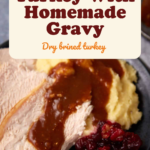
This juicy dry brined turkey gets a simple salt and brown sugar rub the night before, so there’s no wet brine and no giant bucket to find room for in your fridge. Softened unsalted butter goes under the skin, and the turkey roasts on thick slices of yellow onion that flavor the pan drippings for a rich homemade gravy. Follow the steps and the roasting times by weight below for a golden, tender turkey you can feel confident serving.

Dry Brined Turkey and Gravy Made in One Pan
If you’ve never cooked a turkey, I promise this is the easy way to do it. You don’t have to stay up all night with it to baste it every few minutes. It goes in the oven first thing in the morning, and the hour it rests under the foil is what keeps it from drying out. That hour also frees up your oven for the rolls and side dishes.
Ten Years of Dry Brined Turkey
I started dry brining about 10 years ago, and it’s the only way I fix a turkey now. My mother-in-law uses a wet brine and it works, but it’s a mess. The dry brine gets you a very moist turkey without all that. My mom stuffs hers, and you can do that here too, it just takes about 15 minutes per pound instead of 13.

Thanksgiving's Best Recipes!
FREE EMAIL BONUS: My must-try Thanksgiving menu.
Why the Foil Stays On
I keep the whole turkey tightly covered with foil, from the time it goes in the oven until it’s done resting. That keeps the steam in so the breast stays moist. Don’t go by the clock to know when it’s done. You will remove it to baste it once or twice.
Use a meat thermometer and take it out at 160°F in the thickest part of the breast. Leave the foil on for the hour rest, then check that the breast and thigh have hit 165°F before you carve.
That hour is when I bake my old-fashioned yeast rolls made with a flour paste.
Pan Dripping Gravy That Isn’t Salty
You’d think a turkey with a salt rub would make salty drippings, but mine never do. I rinse the brine off before the turkey goes on the onions, and the drippings come out full of flavor. That’s what the gravy is made from. If you don’t have drippings, chicken broth will work, it just won’t taste as good. I spoon it over make-ahead Yukon Gold mashed potatoes with mascarpone, which you can make two days ahead.

What I’d Tell You Before Thanksgiving Morning
- Thaw your turkey in the fridge, never on the counter. Figure about a day for every 4 to 5 pounds, so a 15-pound turkey needs 3 to 4 days.
- Check inside the cavity for ice, and pull out the neck and giblets before you add the rub.
- Rinse the brine off in the sink and pat the turkey dry. Then clean the sink and counters really well, because raw turkey juice gets everywhere.
- A meat thermometer is a lot more reliable than the pop-up timer. At 350°F it takes about 13 minutes per pound if it’s not stuffed and 15 if it is, so a 15-pound turkey is about 3 hours 15 minutes unstuffed and 3 hours 45 minutes stuffed.
What You’ll Need for Dry Brined Turkey and Gravy
- Turkey: This is written for a 12 to 18 pound turkey. If yours is smaller or larger, adjust the rub and the roasting time.
- Kosher salt: Use kosher salt for the rub. Fine table salt is much saltier by the cup, so don’t swap it in.
- Brown sugar: There’s only a tablespoon in the rub. It’s there to help the skin brown.
- Onions: I use basic yellow onions, sliced thick so they hold up under the turkey for the whole roast.
- Butter: Use unsalted butter at room temperature so it spreads easily under the skin.
- Turkey stock: This is just the juices left in the roasting pan after the turkey is done, so there’s nothing to buy or make. If you come up short of 4 cups, add chicken broth.
Step-by-Step Instructions for Making a Roast Turkey
Step One: Prepare the Turkey
Let the turkey thaw in the fridge. Rub the turkey all over with a mix of salt and brown sugar, then chill it uncovered in the fridge overnight. Take it out of the fridge about an hour before you put it in the oven.

// roasting pan with wire rack //
Step Two: Add Butter and Onions
Rinse off the brine and pat it dry. Loosen the skin and work softened butter underneath, spreading some on the outside too. Layer thick slices of onion in the roasting pan to add flavor and act as a base.


Step Three: Roast the Turkey
Place the turkey on a rack over the onions, cover it with foil, and bake at 350º until the internal temperature in the thickest part of the meat is 160º. Let it rest under the foil to finish cooking for an hour until it reaches 165º.

// twine / turkey baster / meat thermometer //
Step Four: Make the Gravy
Drain the pan juices into a bowl, skim off the turkey fat, and save the pan drippings. In a saucepan, or the roasting pan, whisk together butter and flour. Slowly stir in the turkey juices and simmer until the gravy thickens to your desired consistency. Season to taste and pour over the carved turkey.

Storage and Leftovers
Leftover turkey keeps in the fridge for 3 to 4 days, or you can freeze it for up to 3 months. My favorite way to use it up is a classic Kentucky hot brown with béchamel cheese sauce. It’s turkey on toasted bread with a creamy cheese sauce, bacon, and a slice of tomato, broiled until bubbly. Leftover turkey is also good in casseroles that call for chicken, and it makes great sliders.
With a handful of pantry ingredients and a night in the fridge, even a first-time cook can put a turkey and gravy on the table they’re proud of. Round out the table with more Thanksgiving side dishes.
If you loved this recipe, give it a star ⭐️⭐️⭐️⭐️⭐️ rating! Also, snap a picture of your finished dish and share it with me on Instagram using the hashtag #butterandbaggage and tagging me @butterandbaggage.

Juicy Dry Brined Turkey with Homemade Gravy
Equipment
Ingredients
- 12 – 18 lb turkey
- ¼ cup Kosher salt
- 1 tablespoon brown sugar
- 2 onions thickly sliced
- 1 cup unsalted butter room temp
Gravy
- 3 tablespoons unsalted butter
- ¼ cup all-purpose flour
- 4 cups turkey stock
Instructions
- Let the turkey thaw in the refrigerator. Remove the neck and giblets, rinse and pat dry. Combine salt and brown sugar in a small bowl and combine with your fingers. Rub it all over the turkey, inside and outside. Place on a rack in a roasting pan and chill, UNCOVERED, for at least 12 hours but up to 24 hours. Remove from the refrigerator an hour before placing in the oven.
- Rinse the turkey and the roasting pan. Use your fingers to loosen the skin and work the softened butter under the skin. Rub some of the butter on the outside of the turkey. Place thickly sliced onions on the bottom or the roasting pan. Place the turkey on a wire rack on top of the onions and cover with foil.
- Bake at 350º for 3-6 hours until a meat thermometer in the thickest part of the breast and thigh reaches 160º. Let it rest, still covered, for at least an hour where it will continue to cook and reach 165º.
Gravy
- When ready to serve, remove the turkey and drain the juice through a colander to remove the onions. Let it sit for a minute for the fat to float to the top. Remove the fat.
- If your roasting pan can go on the stove, use it. If not, use a medium saucepan. Add 3 tablespoons of butter and heat over medium heat, scraping up any bits from the bottom of the roasting pan. Add flour and whisk for about a minute. Slowly add the turkey juices and whisk until smooth and thickened. Add salt and pepper if needed.
Barbara’s Tips + Notes
- Take the turkey out at 160°F in the thickest part of the breast, keep it covered for the hour rest, then check that the breast and thigh read 165°F.
- A stuffed turkey takes about 15 minutes per pound at 350°F, instead of 13 for an unstuffed one.
- No drippings? Chicken broth works for the gravy, it just won’t have as much flavor.
- Put leftovers in an airtight container in the fridge within 2 hours of serving, where they keep 3 to 4 days, or freeze them for up to 3 months.
Nutrition
 Follow Me On SocialDid you make this recipe? Mention @ButterandBaggage or tag #ButterandBaggage
on Instagram!
Leave a Reply